'Abdu'l-Baha
July 26, 2014
July 19, 2014
"...every person must acquire a craft."
Thou hast written regarding thy meeting with... He hath
written that he desireth to teach thee one of the crafts and show thee
affection and consideration. We beseech God that this purpose may be attained,
and thou wilt learn such a skill, for according to the divine ordinances, every
person must acquire a craft.
(‘Abdu’l-Baha, The Compilation of Compilations
vol. I, The Arts)
July 12, 2014
Divine Prophets are Manifestations of Truth
From: Talks of ‘Abdu’l-Baha
November 24, 1911
At the home of Mademoiselle Gastea, Paris, France
All the divine prophets are the Manifestations of Truth. His Highness Moses
declared the Truth. His Highness the Christ spread the Truth. His Highness
Muhammad established the Truth. All the Chosen Ones of God proclaimed the
Truth. His Highness Baha’u’llah unfurled the ensign of Truth. All the
sanctified souls who have stepped into the arena of existence have been the
lamps of Truth.
Truth is the oneness of the kingdom of humanity. Truth is love among the
children of men. Truth is the proclamation of Justice. Truth is divine
guidance. Truth is the virtues and perfections of the human world. Truth is
equality between the people of all countries. Truth is the illumination of the
realm of man.
All the prophets of God have been the heralds of Truth. All have been united
and agreed on this principle. Every prophet predicted the coming of a successor
and every successor acknowledged the Truth of the predecessor.
Moses prophesied the coming of Christ. Christ acknowledged Moses. His Highness
Christ foretold the appearance of Muhammad, and Muhammad accepted the Christ
and Moses. When all these divine prophets were united with each other, why
should we disagree? We are the followers of those holy souls. In the same
manner that the prophets loved each other, we should follow their example, for
we are all the servants of God and the Bounties of the Almighty are encircling
every one.
July 5, 2014
June 25, 2014
How early Eastern believers viewed birthday celebrations
It is interesting to note that the early believers in the
East during the days of Bahá'u'lláh and ‘Abdu'l-Bahá never celebrated their own
birthdays. They considered that such an act would imply self-glorification, a
means of boosting one's ego. It never crossed their minds that a certain day
was their birthday. So real and genuine was this attitude that a great many
individuals did not know the exact date of their birth. In the absence of birth
certificates, some parents would record the date of the birth of their children
in a certain book, much as Westerners used the family Bible for the same
purpose. Even then an individual would be deeply insulted if someone wanted to
celebrate his birthday, [1] for the only persons whose birthday merited
celebration were the Prophets and Chosen Ones of God. Instead of celebrating
birthdays, however, these people held regular annual memorial meetings,
inviting their friends to join in remembering one of their loved ones who had
passed away. In such a meeting, they prayed for the progress of his soul,
recounted his services to the Cause, described his qualities, recited Tablets
revealed in his honour, if any, and offered charitable donations on his behalf.
This practice of annual remembrance of the departed, which is not a binding
obligation in the Bahá'í Faith, is now followed by many Bahá'í families. The
organisation of such meetings is not usually the responsibility of the
institutions of the Faith. They are arranged by individuals on the
anniversaries of the passing of their loved ones.
(Adib Taherzadeh, ‘The Covenant of Baha'u'llah’)
[1] It must be noted that there is nothing in the Bahá'í writings either to
condemn the celebration of one's birthday or to encourage it. (Adib
Taherzadeh, ‘The Covenant of Baha'u'llah’)
June 18, 2014
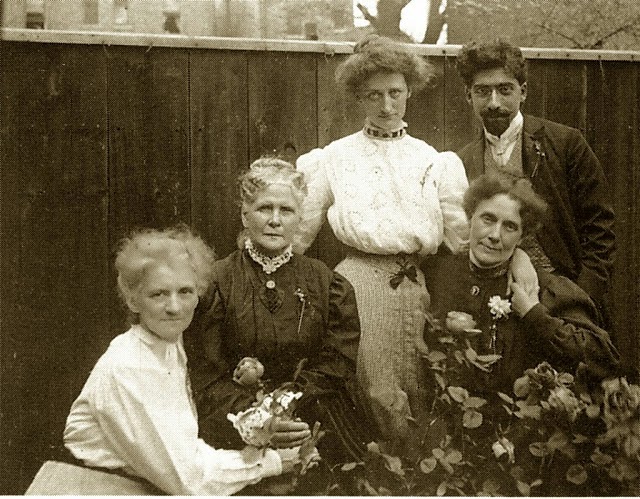
1903: Some Baha’is from Chicago
Some Baha’is from Chicago with Dr. Farid, who translated
many of ‘Abdu’l-Baha’s talks in the West but later disgraced himself.
June 11, 2014
Paragraph 1.7 of Surih of Temple in 'The Summons of the Lord of Hosts'
"Pointing with her finger unto My head, she
addressed all who are in heaven and all who are on earth, saying: By God! This
is the Best-Beloved of the worlds, and yet ye comprehend not. This is the
Beauty of God amongst you, and the power of His sovereignty within you, could
ye but understand. This is the Mystery of God and His Treasure, the Cause of
God and His glory unto all who are in the kingdoms of Revelation and of
creation, if ye be of them that perceive. This is He Whose Presence is the
ardent desire of the denizens of the Realm of eternity, and of them that dwell
within the Tabernacle of glory, and yet from His Beauty do ye turn aside."
Comments:
Let’s repeat the incredible pronouncements that the Maid of Heaven
(representing the Most Great Spirit) makes concerning Baha’u’llah:
· “the Best-Beloved of the worlds”;
· “the Beauty of God amongst” us;
· “the power of His[God’s] sovereignty within” us;
· “the Mystery of God and His[God’s] Treasure;
· “the Cause of God and His[God’s] glory unto all who are in the kingdoms of Revelation and of creation”;
· “He Whose Presence is the ardent desire of the denizens of the Realm of eternity..”;
· “He Whose Presence is the ardent desire of … them that dwell within the Tabernacle of glory…”
· “the Beauty of God amongst” us;
· “the power of His[God’s] sovereignty within” us;
· “the Mystery of God and His[God’s] Treasure;
· “the Cause of God and His[God’s] glory unto all who are in the kingdoms of Revelation and of creation”;
· “He Whose Presence is the ardent desire of the denizens of the Realm of eternity..”;
· “He Whose Presence is the ardent desire of … them that dwell within the Tabernacle of glory…”
These are awe-inspiring references!
As we know the Bab explains that all Manifestations of God are representations of one Entity -- the Primal Will of God. The attributes of the Primal Will that these Manifestations of God were allowed by God to gradually and progressively reveal to mankind, however, were in accordance to our evolving capacity. Baha’u’llah’s mission was to bring the attributes of “Glory” and “Splendor” to our midst – in both this life and the life after!
Here is the reference from the Báb about the Primal Will of God:
June 4, 2014
The effect of 'Abdu'l-Baha's visit on Britain and the spiritual qualities of British believers
That in every one of you our departed Master reposed His
future and truest hopes for an able and convincing presentation of the Cause to
the outside world, is abundantly revealed in His spoken and written words to
you, as well as in His general references to the spirit of sincerity, of
tenacity and devotion that animates His friends of that land.
The fierce tests that have raged over that island in the past; the calm and
determination with which they have been so bravely faced and surmounted; the
seeds of loving fellowship that the Beloved in person has more than once
scattered in its soil; the rise, as its result, of a few but indeed capable,
reliable, devoted and experienced followers and admirers of the Cause; the
splendid and in many instances unique opportunities that are yours -- these
indeed are cherished thoughts for a land that illumines its past and should
cheer its future. (Shoghi Effendi, excerpt from a letter dated 16 December
1922 to Baha'is in Great Britain; The Unfolding Destiny of the British Baha'i
Community, p. 10) (To see the entire letter please visit Messages to the
Baha'i World)
May 28, 2014
Difficulties Experienced by Each Manifestation of God
Judge thou fairly, I adjure thee
by God. What proof did the Jewish doctors adduce wherewith to condemn Him Who
was the Spirit of God (Jesus Christ), when He came unto them with truth? What
could have been the evidence produced by the Pharisees and the idolatrous
priests to justify their denial of Muhammad, the Apostle of God when He came
unto them with a Book that judged between truth and falsehood with a justice
which turned into light the darkness of the earth, and enraptured the hearts of
such as had known Him? (Baha'u'llah, Epistle to the Son of the Wolf, p.
81)
Consider and call thou to mind the days whereon the Spirit of God (Jesus
Christ) appeared, and Herod gave judgment against Him. God, however, aided Him
with the hosts of the unseen, and protected Him with truth, and sent Him down
unto another land, according to His promise. He, verily, ordaineth what He
pleaseth. Thy Lord truly preserveth whom He willeth, be he in the midst of the
seas or in the maw of the serpent, or beneath the sword of the oppressor." (Baha'u'llah,
Epistle to the Son of the Wolf, p. 57)
He that married not (Jesus Christ) could find no place wherein to abide, nor
where to lay His head, by reason of what the hands of the treacherous had
wrought. His holiness consisted not in the things ye have believed and
imagined, but rather in the things which belong unto Us. Ask, that ye may be
made aware of His station which hath been exalted above the vain imaginings of
all the peoples of the earth. Blessed are they that understand. (Baha'u'llah,
Epistle to the Son of the Wolf, p. 49)
May 21, 2014
The Constitution of the Universal House of Justice
The Constitution of the Universal House of Justice is referred to by the
beloved Guardian as the “Most Great Law of the Faith of Baha’u’llah” (The
Universal House of Justice, Ridvan 130, 1973). It
contains 16 pages and is divided into two sections:
1. Declaration of Trust; and
2. By-Laws
For an inspiring and informative review of its contents, please see the
transcript of a talk given by Mr. Ali Nakhjavani, a member of the House of
Justice. A copy is posted at Baha’i Talks
May 14, 2014
Divine Lote-Tree
From: Baha’i Glossary
A reference to the tree beyond which there is no passing - in
ancient times, the tree that Arabs planted to mark the end of a road. In Islam,
the term symbolizes the point in the heavens beyond which neither humans nor
angels can pass in their approach to God, thus delimiting the bounds of divine
knowledge as revealed to humankind. In Baha’i usage it is a reference to the
Messenger of God - i.e., Baha’u’llah.
May 7, 2014
Quiz 10
From: Baha’i Knowledge Hunt
• ‘Abdu’l-Baha is reported to have said that one’s “faith embodies three
degrees”. Can you name them? Answer
• Baha’u’llah’s vision of a “Maiden”, which the Guardian explains in God Passes
By as the representation of the “Most Great Spirit” is compared to the “sacred
fire, the Burning Bush, the Dove and the Angel Gabriel” in which religions,
respectively? Answer
• Which Baha’i sacred tombs lie at the center of the arc on Mount Carmel that
accommodates the buildings of the Universal House of Justice, the International
Teaching Center, the Center for the study of the Text, and the International
Archives? Answer
• How was Baha’u’llah related to Abraham? Answer
• How old is the seaport of Akka? Answer
• It is the first time in known history that a Messenger of God is known to be
on this continent. Which continent is it? Answer
April 30, 2014
Baha'u'llah Sought Justice as a Child
From: Baha’i Stories
While still a child, the Blessed Beauty (Baha'u'llah)
watched as a government tax-collector, on three separate occasions, accosted
His father and demanded, in cruel and unjust manner, the payment of taxes.
Unable to bear the injustice of it all, He, though in early childhood, mounted
His horse and rode fpr two days until He arrived in Tihran (the capital of
Persia). There He sought the dismissal of this unjust and tyrannical
tax-collectot. He succeeded in obtaining the necessary papers ordering the
dismissal, and returned to His parents.
(Mr. Furutan, ‘Story of
Baha'u'llah’)
April 24, 2014
Hand of the Cause Enoch Olinga with his family
From: We are Baha’is
April 17, 2014
Each believer should “pattern his life according to the Teachings” – no “set of rigid regulations”
It is neither possible nor desirable for the Universal House
of Justice to set forth a set of rules covering every situation. Rather is it
the task of the individual believer to determine, according to his own
prayerful understanding of the Writings, precisely what his course of conduct
should be in relation to situations which he encounters in his daily life. If
he is to fulfil his true mission in life as a follower of the Blessed
Perfection, he will pattern his life according to the Teachings. The believer
cannot attain this objective merely by living according to a set of rigid
regulations. When his life is oriented toward service to Bahá'u'lláh, and when
every conscious act is performed within this frame of reference, he will not
fail to achieve the true purpose of his life.
Therefore, every believer must continually study the sacred
Writings and the instructions of the beloved Guardian, striving always to
attain a new and better understanding of their import to him and to his
society. He should pray fervently for Divine Guidance, wisdom and strength to
do what is pleasing to God, and to serve Him at all times and to the best of
his ability.
(From a letter dated 17 October 1968 written by the Universal
House of Justice to an individual believer; The Compilation of Compilations,
vol. I, a Chase and Holy Life)
April 10, 2014
Going to Mashriqu'l-Adhkár at dawn
From: Daily Verses
of God
Blessed is he who, at the hour of dawn, centering his
thoughts on God, occupied with His remembrance, and supplicating His
forgiveness, directeth his steps to the Mashriqu'l-Adhkár and, entering
therein, seateth himself in silence to listen to the verses of God, the
Sovereign, the Mighty, the All-Praised. Say: The Mashriqu'l-Adhkár is each and
every building which hath been erected in cities and villages for the
celebration of My praise. Such is the name by which it hath been designated
before the throne of glory, were ye of those who understand.
(Baha’u’llah,
the Kitab-i-Aqdas)
April 3, 2014
1913: Baha’i students at Beirut School
1913 - Some Baha’i students with their teachers at Beirut
School. Shoghi Effendi is indicated by an “x”.
March 27, 2014
October 27, 1957: Shoghi Effendi caught Asiatic influenza in London and a doctor prescribed medicine
On Sunday afternoon[while in London], October 27th, Shoghi
Effendi told Ruhiyyih Khanum that he had a pain across his knuckles in both
hands; she asked him if he had any other pains, and he said no, that just his
fingers pained him and were stir He added: "I feel so tired, so
tired." She begged him to rest, saying that if he did not wish to go to
bed, at least he should rest quietly because the probability was that he was
getting the influenza which was sweeping through Europe and indeed all over the
world. (She herself had been in bed with fever since Thursday night.) That
night he had a fever and by the following day his temperature had risen to
thirty-nine degrees. Ruhiyyih Khanum succeeded in finding an excellent doctor
who had taken over the practice of a well-known Harley Street physician who had
retired. This doctor was contacted and immediately prescribed medicine for the
beloved Guardian and came to see him early in the evening when he was able to
get away from his hospital. He examined his patient very carefully; heart,
chest, temperature, pulse, etc., and said that he considered that both the
Guardian and Ruhiyyih Khanum had cases of Asiatic influenza, the beloved
Guardian's case being the more severe.
(Ruhiyyih Khanum, ‘The Passing of Shoghi
Effendi’)
March 20, 2014
To train our soul in this life so that “at the hour of death, [it will] ascend, in the utmost purity and sanctity and with absolute detachment.”
The Prophets and Messengers of God have been sent down for
the sole purpose of guiding mankind to the straight Path of Truth. The purpose
underlying Their revelation hath been to educate all men, that they may, at the
hour of death, ascend, in the utmost purity and sanctity and with absolute
detachment, to the throne of the Most High.
(Baha'u'llah, Gleanings from
the Writings of Baha'u'llah)
Subscribe to:
Posts (Atom)